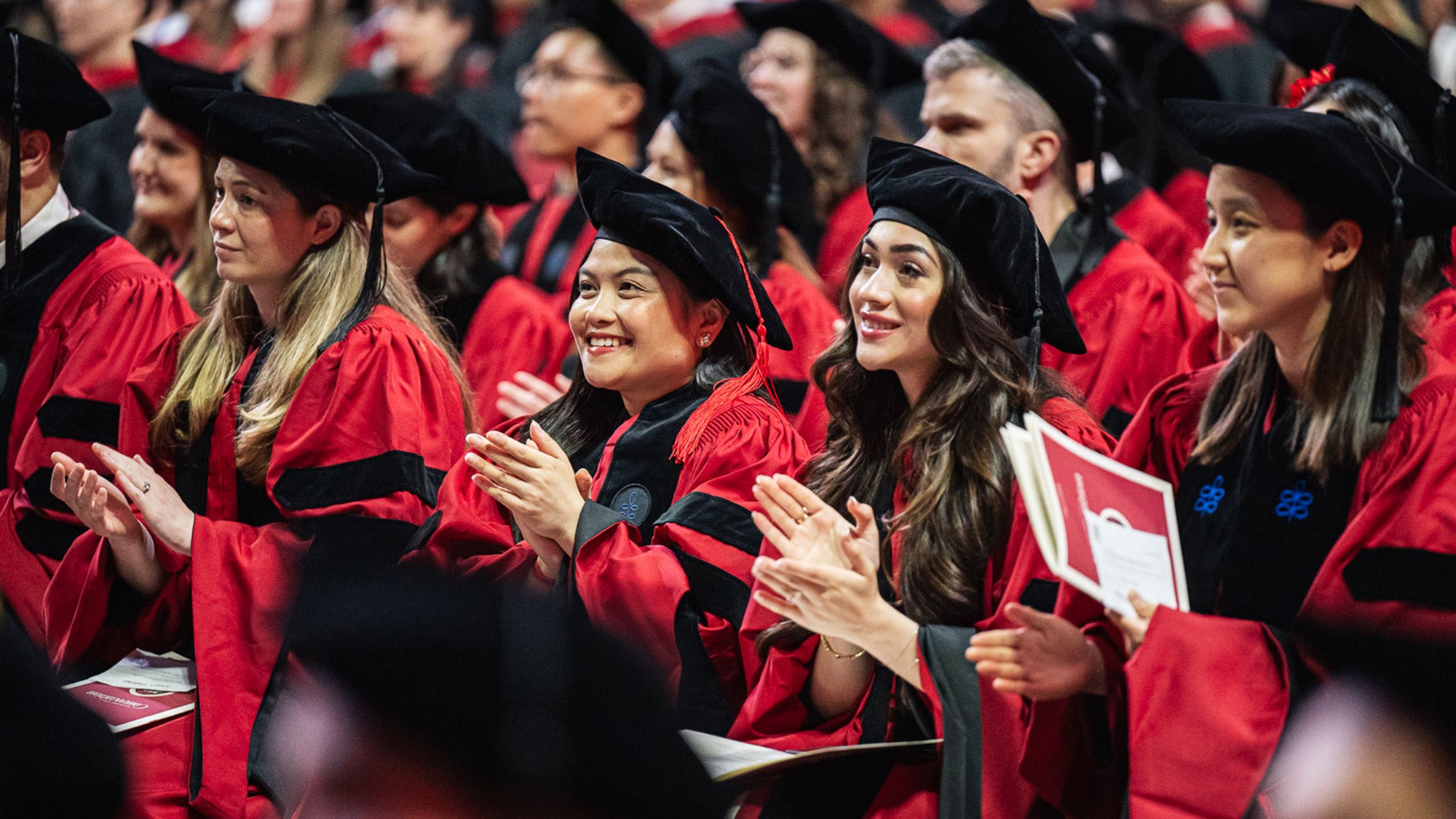
Commencement Address
HSPH 86th Commencement Ceremony
June 4, 2009
Thank you to Dean Frenk, thank you to former Dean Bloom, and thank you most of all to the graduates for asking me to speak to you on the occasion of your graduation. It is a tremendous honor. I am grateful. Thank you.
And I would now like to proceed by ignoring you. And instead, I want to speak to your family and your friends who have gathered here in celebration.
I know you are proud, and I know that right now, in the midst of this terrible economy, you are asking yourselves, what are these people really going to do with a public health degree? How are they going to make some money? And who, in the end, are of these people?
It's interesting that in one way or another, Hope, Dean Frenk and I have felt the need to explain to you a little bit about what it is that your children, spouses, friends have been doing here. But I think it's important, because we're on the cusp of a dramatic change in this new century. And these are the people who are equipped better than anyone in our society to take on one of the central struggles of our time — how we live as mortal beings.
We have arrived, I think, at a difficult point in human history. For millennia, before this moment in time, we had little knowledge of what to do to improve and sustain the health of human beings. We lived in ignorance. The average longevity of a person was under 40 years. The body, and how it failed, was largely a mystery.
The 20th century, however, brought an age of remarkable discovery. In the last century, scientists have come to recognize more than 60,000 different diseases and disorders that can afflict the human body — 60,000 different ways the human body can fail. And they have discovered methods of prevention and treatment for nearly all of them — if not to cure them, then at least to alleviate their worst harm and misery.
That knowledge has ranged from how to construct sewage systems well, to how to provide intensive care technologies. And that knowledge is continuing to grow. But having discovered so much, we have hit, in this new century, a new problem — how to actually deliver on all that has been learned.
When Alexander Fleming discovered penicillin in 1928, it was, I think, a kind of fake-out for the future of medicine and for public health. Fleming gave us a simple injection that could cure numerous infectious conditions, and it led us to believe that managing disease would be easy and cheap.
But 80 years later, we found that the truth is far from this. The reality came home to me a few years ago during a trip to India, my ancestral home. India has seen dramatic increases in longevity with economic advances in recent decades, from an average life expectancy in the mid-40s at the time of independence — an average life expectancy that was just in the mid-40s at the time of independence in the mid '40s, to where it's 65 years today. China's survival is 70. Vietnam, it's 72 years.
And going to India, it has proved to be a profound effect on the nature of disease. The number one killer there is no longer diarrheal illness or respiratory infections — it's cardiovascular disease. Road traffic accidents and injuries are in the top five. Cancer is in the top ten. But they have a health system that was built for infectious disease, and on only $20 per person per year for healthcare and public health, it wasn't clear how they could do anything about these problems.
My father comes from a small village in Maharashtra, 400 miles east of Mumbai. Most of his family is still there. He is one of 13 brothers and sisters. They are my aunts and uncles. And they are farmers, still — cotton, sugar cane, and a type of wheat called jowar are their cash crops. Drip irrigation has allowed them two crops a year. They have had, as a result, a degree of prosperity. Malnutrition is no longer an issue. They have malaria, or a diarrheal illness, but a cottage hospital nearby has been able to provide effective, basic care.
But the villagers began to have problems that will seem quite familiar to us here. One uncle had his hip shattered in a motorcycle accident. Another has high blood pressure and chest pains from heart disease. One cousin was disabled with kidney stones.
So for these kinds of problems, what do they do? What they do is travel to the government hospital in Nanded, which is 70 miles away. It is the lone public hospital serving a district of 1,400 villages and 2.3 million people. It has 500 beds, three operating rooms, and I found when I visited as a visiting surgeon, just nine surgeons. You have to imagine Kansas with just nine surgeons.
They arrive each morning to a crush of 200 people pressing their way into clinic, and one of the puzzles for me in visiting was, how does a surgeon do it? How do they possibly take care of all of the hernias, and stab wounds, and appendicitis cases, and tuberculosis abscesses, and sleep, live themselves?
The answer, I figured, was triage. The clinic was like many you find in India. They were ovens in the heat of summer. Each room had a metal desk and some chairs, a ceiling fan stirring, and at any given moment, six, sometimes eight patients jockeying for attention. Among them was a silent, scared woman in her 30s who undid her sari when we took her behind a thin rag curtain to examine her. And when she did, she revealed a fist-sized tumor in her breast. It was fixed to the skin, which is an ominous sign.
Before arriving in India, I had assumed that the complex, expensive treatments such advanced cancers require — chemotherapy, radiation and surgery — would be beyond the capabilities of the doctors there, and the surgeons would send the patients home to die.
But the surgeons did no such thing. It was unacceptable. Instead, the surgeon on duty admitted the woman to the hospital and started her on chemotherapy that afternoon himself. I, as a surgeon, have no idea how to safely administer chemotherapies. In the West, we say this is something too difficult for anybody but oncologists to do. But India has manufacturers who produce cheap, often pirated versions of most drugs, and the surgeons there have learned how to dose and administer the Cyclophosphamide, Methotrexate and Fluorouracil themselves, in makeshift treatment rooms of benches and folding chairs. They make compromises, out of necessity. But they got the patients through.
At every step, the surgeons did what they could. It was textbook treatment, devised by other means. But the onslaught remained. I watched a single surgeon try to see 15 patients an hour in clinic. In one morning, he identified more patients who needed surgery than they had facilities or personnel for in a week. And it was like that every day.
The needs of our world have shifted in ways that alter our conception of public health. There's been an explosion of complex needs like these as much of the world's population live past infectious disease. And so, consider my field of surgery. We now have 230 million people a year undergoing major surgery in the world. The volume now exceeds that of childbirth, but with death rates 10 to 100 times higher. And, on the other hand, we still have 2 billion people without access to essential surgery for endangered childbirth, for traumas, for other kinds of emergencies.
If we are to save lives and use health resources wisely, we have to think about our health systems in all their dimensions — how they cope with everything from malaria to surgery. For we've generated tremendous scientific knowledge, but not the capacity to deliver on it reliably, safely, humanely, or equitably.
Closing this gap is the work of public health. It has become the pivotal struggle of our era. And that has become true not only in the poorest parts of the world.
Recently, I helped care for a critically ill woman in her 60s here in Boston, with severe abdominal pain from a bowel obstruction that ruptured her colon. She arrived in shock and renal failure, and then she had a heart attack. A simple injection was not going to help her.
There were several things that struck me about what was required to help her. First was that much of her worst troubles were preventable with knowledge that we have today and that we didn't have just a few decades ago. She'd had high blood pressure, high cholesterol, and signs of heart disease that had gone untreated, and she'd had several weeks of abdominal pains that had gone unattended. She was now at death's door, but in our modern age, she didn't have to be.
Insurance coverage problems may have played a role. She had not seen a physician in 15 years. Our system had failed her before she even arrived.
A second thought occurred to me as we rushed her from the emergency room to the operating room, and that was, that it wasn't very long ago that we would have been unable to even try to help her in this situation. Her problems were too complex, she was too sick, but techniques of anesthesia, surgery, cardiology and intensive care had been perfected. Our greatest struggle now was less with knowing what to do, than with knowing how to make it go right, without errors. And indeed, it was public health people who discovered that errors in medicine have become as great a cause of avoidable harm and death in the United States as many diseases.
To try and save her, I operated to repair her ruptured colon. A cardiologist treated her heart attack. An intensivist managed her shock, and a vascular surgeon tried to rescue her foot, which had become gangrenous and would have to be amputated.
We managed to escape major errors, and a week later, she was on the mend. But that was when we encountered one further problem.
It doesn't take long, after a case like hers, to begin to wonder how well we're equipped, not just to save people, but also to help them live. As we contemplated the possibility that she'd be able to leave the hospital, and considered that when she went home, she'd be unable to walk, unable to eat for months, and have a large open wound, someone asked, who's going to be her doctor? Who's going to take care of her?
The silence was deafening. Her care was too complex for a lone primary physician, but in our current fragmented health system, we had no real mechanism, let alone incentives, to ensure that all the specialists could function as a team, and ensure that nothing fell between the cracks — that we were all working in a common direction for her.
In the end, she didn't make it out of the hospital. She got a simple pneumonia during her second week, and that was simply too much for her. I wondered if we'd gone too far and only prolonged her suffering. And when we pronounced her dead, with her family by her side, I realized that here, with this one patient, in this hospital right behind me, in the most technologically advanced country on the planet, we too were struggling with a system that is failing our people.
We've had a century of extraordinary scientific discovery about human health. But we have found ourselves with yawning gaps in our ability to provide it to people here and around the globe. We have trouble managing its complexity, its costs, and its implications for everything from how countries should structure their health systems, to how we, as individuals, should manage the end of our own lives.
Making it so the people of the world can live lives as free from disease and suffering as possible is the work of public health. And we have learned it will require attention to everything from economics, to the environment, to technology, and institutions.
These people sitting here in front of you today will be the ones providing that attention. They are lawyers, engineers, doctors, business people, statisticians, laboratory scientists, policy wonks. We even have musicians. And in coming here, they have sought to take the time to understand how to measure the problems of our world, how to innovate improvements, and how to bring people to implement them wherever they may be.
Leaders, someone once said, are those who seek to solve the hard problems. So who are these people graduating today, then? These are our leaders. We thank them.