


![]() |
![]() |
![]() |
![]() |
|
![]() |
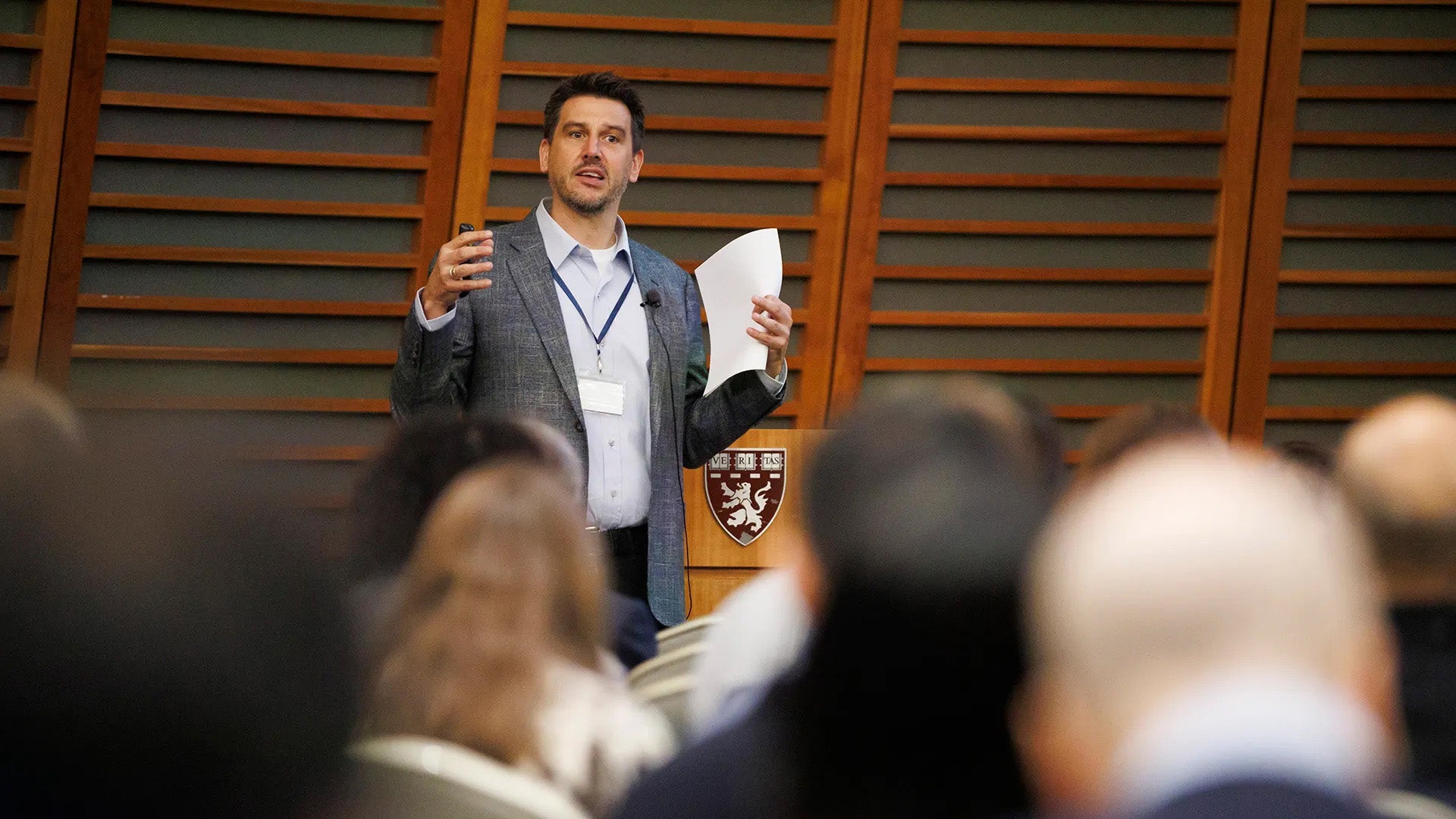
Racial and ethnic health disparities are real, if poorly defined and inadequately researched, but most peopleeven most doctors and people in minority groupsdont believe the inequities exist, said speakers at a recent Harvard symposium on US racial and ethnic disparities research. Thats a problem, because history suggests that substantial change in health policymaking results from pressures of public opinion. "The general public does not believe in many cases that health disparities exist," said Kalahn Taylor-Clark, W.K. Kellogg Fellow in Health Policy Research, in a joint presentation with Robert Blendon, a professor in the Department of Health Policy and Management. In most communities, minorities are not aware that health disparities exist. Based on lack of knowledge and concern, there is not yet a national commitment to address the issue, said Clark, who helped organize the symposium. Even so, Blendon said, "Science plays a big role in long-term policy in the United States. Its important that health disparities research be established as a field of study at schools across Harvard University." If the symposium is any indication, a new generation of researchers feels a fresh sense of urgency about unequal medical treatment and poorer health outcomes. The day-long April 11 symposium registered 270 people from across the country in the first 10 days after it was announced in February. The multi-disciplinary event was sponsored by the Interfaculty Program for Health Systems Improvement at Harvard. It was designed to bring together faculty, students, post-graduates, and doctoral fellows from across Harvard University to form research collaborations in health disparities. A committee of student volunteers, including HSPH members, organized the event, and HSPH faculty presented several lectures. Co-chairs were Debra Joy Perez, W.K. Kellogg Fellow in Health Policy Research, and Carlotta Arthur, W.K. Kellogg Scholar in Health Disparities. "People may be looking to those of you here today to be the leader to guide the research for the next generation," said Arthur. African Americans have the highest death rates from heart disease, cancer, cerebrovascular disease and HIV/AIDS than any other US racial or ethnic group. American Indians disproportionately die from diabetes, liver disease and cirrhosis, and unintentional injuries. Hispanic Americans are almost twice as likely as non-Hispanic whites to die from diabetes. Some Asian-American groups have higher than average rates of stomach, liver, and cervical cancers. All are less likely than whites to have health insurance, have more trouble getting health care, and have fewer choices about where they get their care. A large and growing body of research documents sometimes dramatic disparities in care for different racial and ethnic groups in this country, even after controlling for socioeconomic factors, such as income and insurance. "You have to be in some sort of delusional state to think its not a problem," said Thomas LaVeist, director of the Center for Health Disparities Solutions at Johns Hopkins University. To devise effective interventions, he called for more scientific rigor in diagnosing the underlying problems. "The term health disparities is muddy and unclear," LaVeist said. "It is really two categories: health care disparities and health status disparities. They may have underlying similar causes, but the underlying political will to address the problems is not the same. Health care disparities has an impact on health status. The solution is more clearly defined. Health status disparities is a more complex combination of biological factors, behavioral factors, and social, environmental and economic factors." A black male born in Washington D.C. has a shorter life expectancy than a man born in Ghana, Bangladesh, or Bolivia. Disparities in health outcomes were documented more than a century ago, Blendon said. More recently, attention has focused on the more politically tractable problem of discrimination within the health care system. Last year, the Institute of Medicine (IOM) reported widespread inequities in medical care, said Joe Betancourt, program director for multicultural education at Massachusetts General Hospital. The IOM report found that even well-intentioned health care providers may be unaware of their systematic biases in clinical encounters, which are rooted in normal and pervasive stereotypes and prejudices among social groups. "It was the civil rights movement that desegregated admitting privileges and desegregated wards, not the medical profession," said Joan Reede, HMS dean for diversity and community partnership. Naming the problem, thinking clearly about how racism harms health, and methodically testing the ideas are critical to advancing research, said Nancy Krieger, an associate professor in the Department of Health and Social Behavior. "There is no short cut to hard thinking," she said and pointed out serious flaws in conceptualizing, designing, measuring, analyzing, and interpreting research in the young field. She presented a paper published in the February 2003 American Journal of Public Health, which she developed for a National Institutes of Health symposium she co-chaired last year. Nearly one in five Americans, or 56 million people, is considered clinically obese. Meanwhile, 31 million Americans, including one in six children, face chronic hunger in any given year. Health inequities are one result of the increasing gap between the rich and poor, said Ichiro Kawachi, a professor in the Department of Health and Social Behavior. From 1979 to 1997, incomes in the bottom fifth of households dropped in real terms, the middle fifth of incomes stagnated, and the top one percent saw spectacular income gains, Kawachi said. Several researchers discussed new ways to tease apart the many intertwined complex factors. Blacks living in America who were born outside of the U.S. or blacks born to parents from other countries smoke significantly less than blacks born in this country to US-born parents, according to preliminary results from a study of smoking among immigrants presented by Dolores Acevedo-Garcia, an assistant professor in the Department of Health and Social Behavior. The "immigrant protective effect" extends across other groups, including Latino and Asian, emerges as even stronger in women, and transcends socioeconomic status. About 20 percent of the US population consists of immigrants and their children; together, they represent 70 percent of US population growth, Acevedo-Garcia said. In another presentation, S.V. Subramanian, an assistant professor in the Department of Health and Social Behavior, demonstrated the relevance of multilevel methods for research on racial disparities in health. Based on a preliminary multilevel analysis of data related to 50,000 non-Hispanic whites and blacks residing in 207 US metropolitan areas, he showed significant variation in self-rated health. He provided evidence that housing segregation of whites and blacks by neighborhoods was related to poor health indicators for African Americans. Several speakers said that health disparities research had broader implications. "This is absolutely relevant to population health," Krieger said. "Some of the best understanding of public health has come from trying to think about the roots of disparities." --Carol Cruzan Morton Harvard Public Health NOW is published biweekly by the Office of Communications Harvard School of Public Health 665 Huntington Ave., SPH 1-1312A Boston, Massachusetts 02115 617-432-6052 Editor and Layout: Christina Roache Contributing Writers: Carol Cruzan Morton, Tom Reynolds Calendar Editor: Melitta King Photos Credits: Christina Roache, Suzanne Camarata Archived Issues || HSPH Home Copyright, 2009, President and Fellows of Harvard College |