
![]() |
![]() |
![]() |
![]() |
|
![]() |
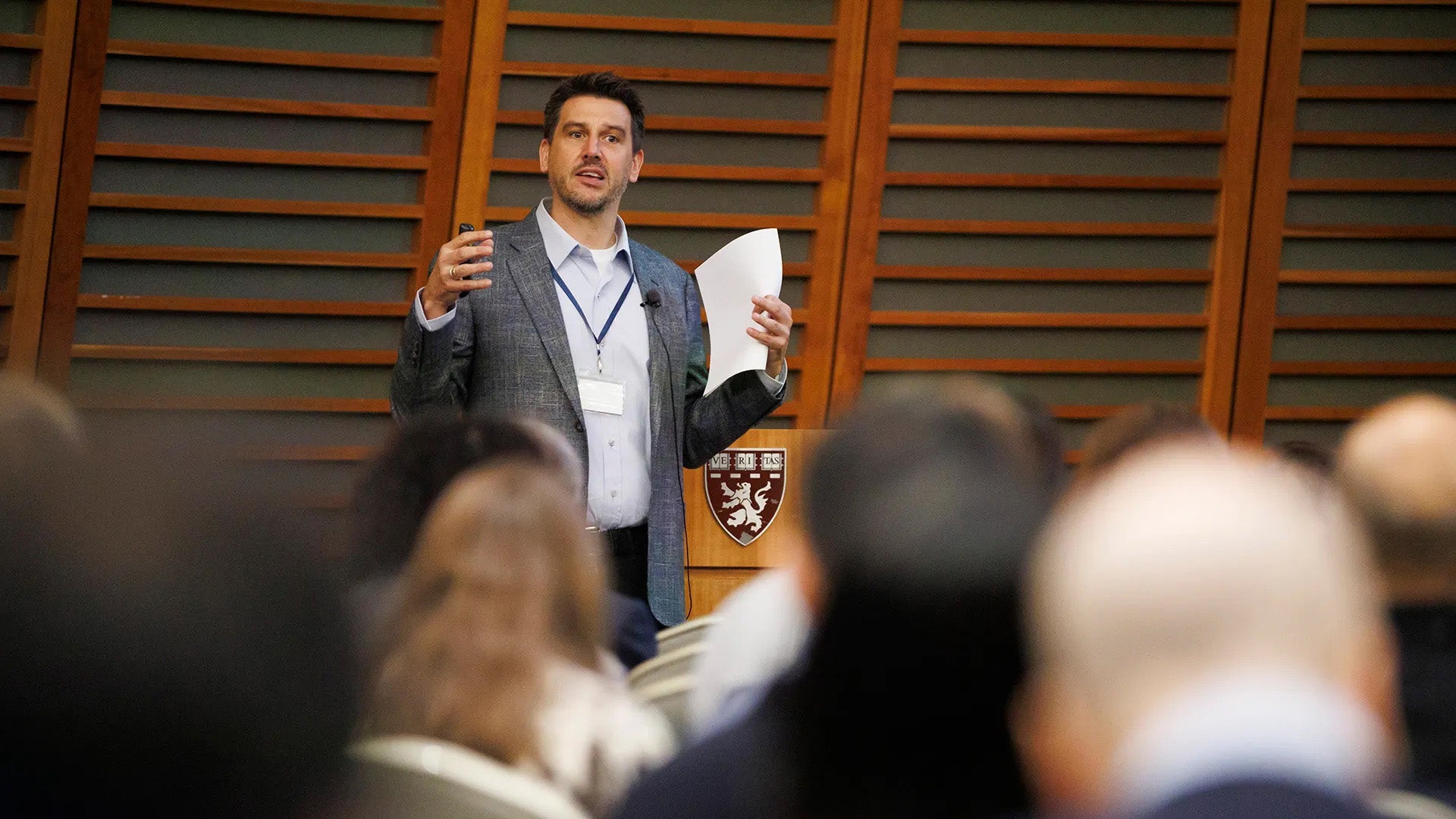
"We have an obligation to make a contribution in what we do to the broader mass of humanity," he said. Attended by approximately 300 people in Snyder Auditorium and two overflow rooms, "Public Health Crisis in Africa" was co-sponsored by the student group Africa Health Forum and the Harvard AIDS Institute. An archived video of the event is available at http://www.hsph.harvard.edu/africa/. Summers said that in parts of Africa, life expectancy is substantially declining. A child is more likely to die before the age of five than to enter secondary school. Two teachers die of AIDS for every one who is trained. Many of the health problems gripping Africa, though, can be addressed by current resources and understanding, he suggested. "When there is a situation in which the greatest problem and challenge facing humanity is also one of the more tractable challenges facing humanity, it behooves us to be seriously engaged," he said. Harvard is already working on several fronts to promote global health, said President Summers. Training students, particularly undergraduates, in studying diseases associated with the developing world will help groom future leaders well-versed in the problems, he said. Developing and disseminating research on an international scaleas was done when SARS transmission was curbed last springis a powerful tool in the battle against global diseases. Lastly, using Harvards reputation to convene meetings of high-powered individuals who can influence global health is another way in which the University can help. What Harvard is not doingnor should be doing, said President Summersis serving as a political advocate or service provider. Instead, he said, "what is unique and special about this place is the reputation it is able to command and the difference it is able to make because of its ability to teach and develop new ideas, and we need to anchor our contributions around those two things." HSPH Projects in Africa HSPH is involved in 80 funded projects in 22 African countries, noted Dean Bloom at the event. For example, the Harvard AIDS Institute has created some of the longest-standing HIV/AIDS research collaborations in Africa.
The School trains students in the epidemiology of infectious diseases. In addition, noted Dean Bloom, students can learn at HSPH the ethics to be considered when conducting studies in developing countries. Dean Bloom asserted that HSPH is not a management or consulting company. Instead, he sketched out a few goals of the School, one of which is to train leadership and "to create a network of scholars who have an association with Harvard and who keep Harvard associated with the world." Another goal is to establish and sustain long-term collaborative relationships with institutions in developing countries, where faculty and students can travel back and forth in ongoing education and research efforts. "Harvard has a certain amount of capitalits people, its time and its credibility," said Dean Bloom. "The question is not whether the world needs advocacy." Instead, he said, the question is how can Harvard be useful. The answer in part is in providing evidence-based medicine and rigorous data that can be used as the basis for decision-making, he said. Case in Point: Harvard AIDS Institute
Essex, an early investigator into HIV/AIDS, reported sobering statistics. At least 70 percent of the worlds AIDS burden is concentrated in sub-Saharan Africa, a region that holds just 10 percent of earths population, he said. Approximately 30 to 32 million people in Africa are HIV-infected. "Unless something changes that we do in the next few years, they will all die," said Essex, "and thats happening at the same time that three-quarters of the patients who are recognized with HIV/AIDS in the West will live, at least live for a decade or two."
Harvard Public Health NOW is published biweekly by the Office of Communications Harvard School of Public Health 665 Huntington Ave., SPH 1-1312 Boston, Massachusetts 02115 617-432-6052 Editor and Layout: Christina Roache Contributing Writer: Paula Hartman Cohen, Carol Cruzan Morton Calendar Editor: Melitta King Photos Credits: Suzanne Camarata, Richard Chase, Paula Hartman Cohen, James Maguire, Christina Roache Archived Issues || HSPH Home Copyright, 2009, President and Fellows of Harvard College |