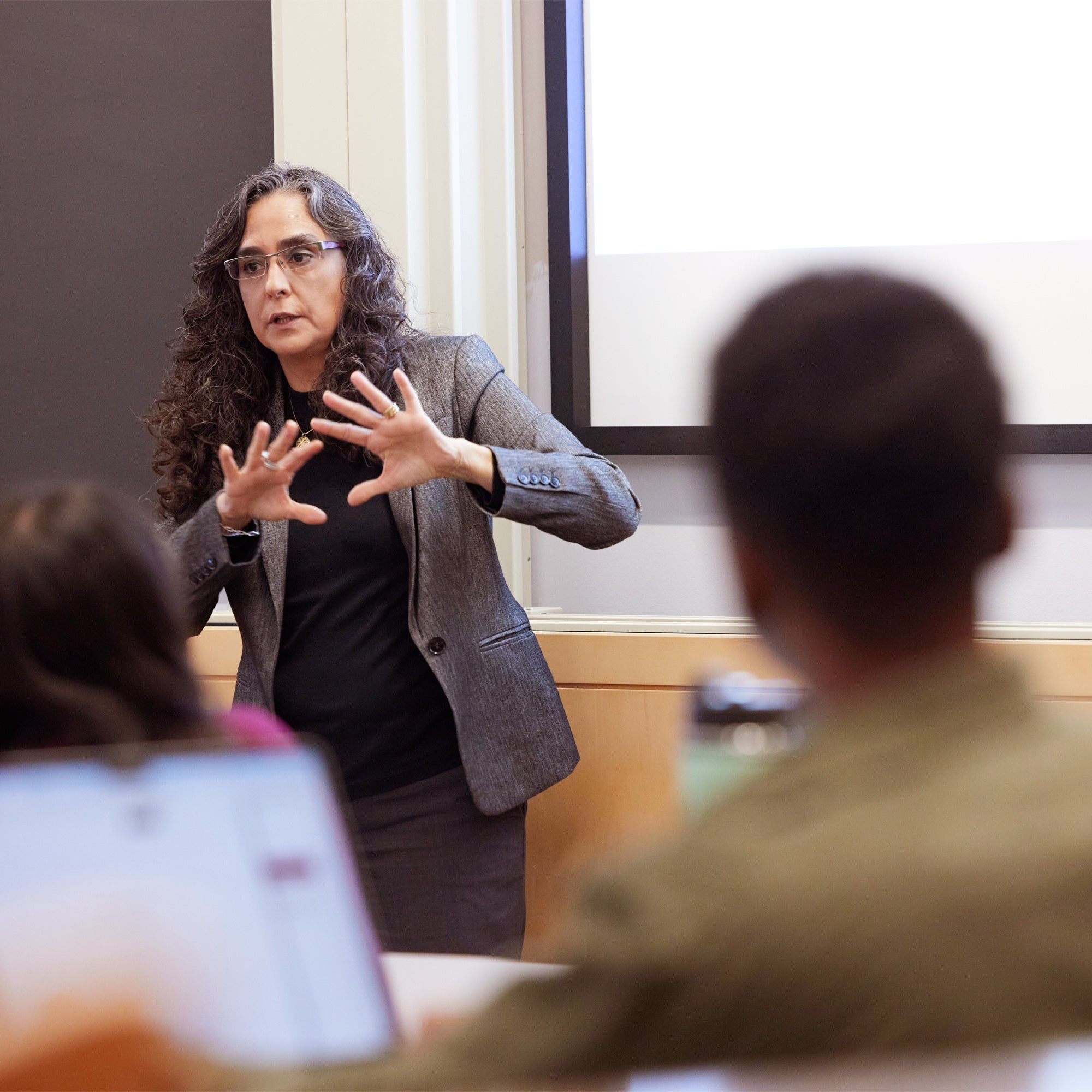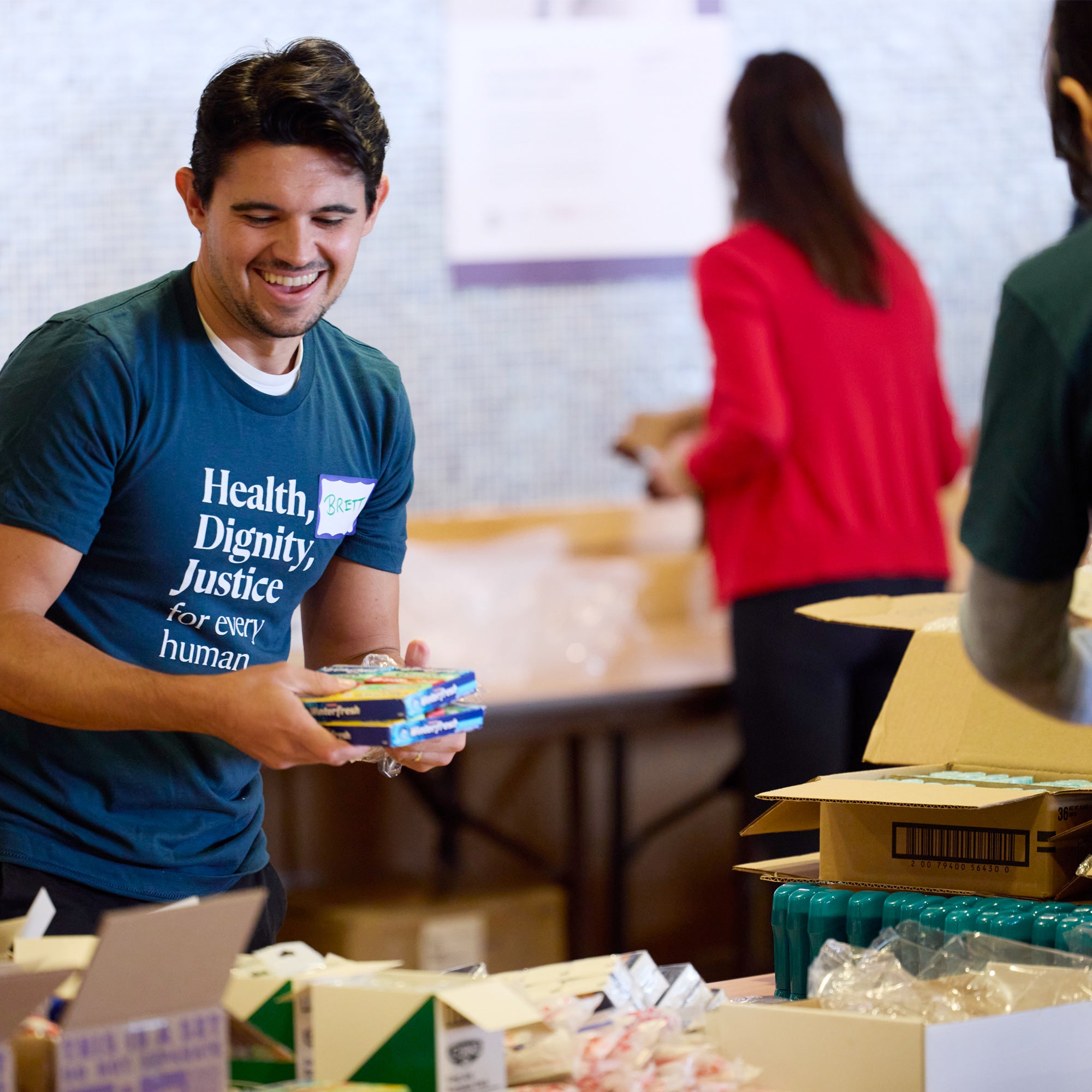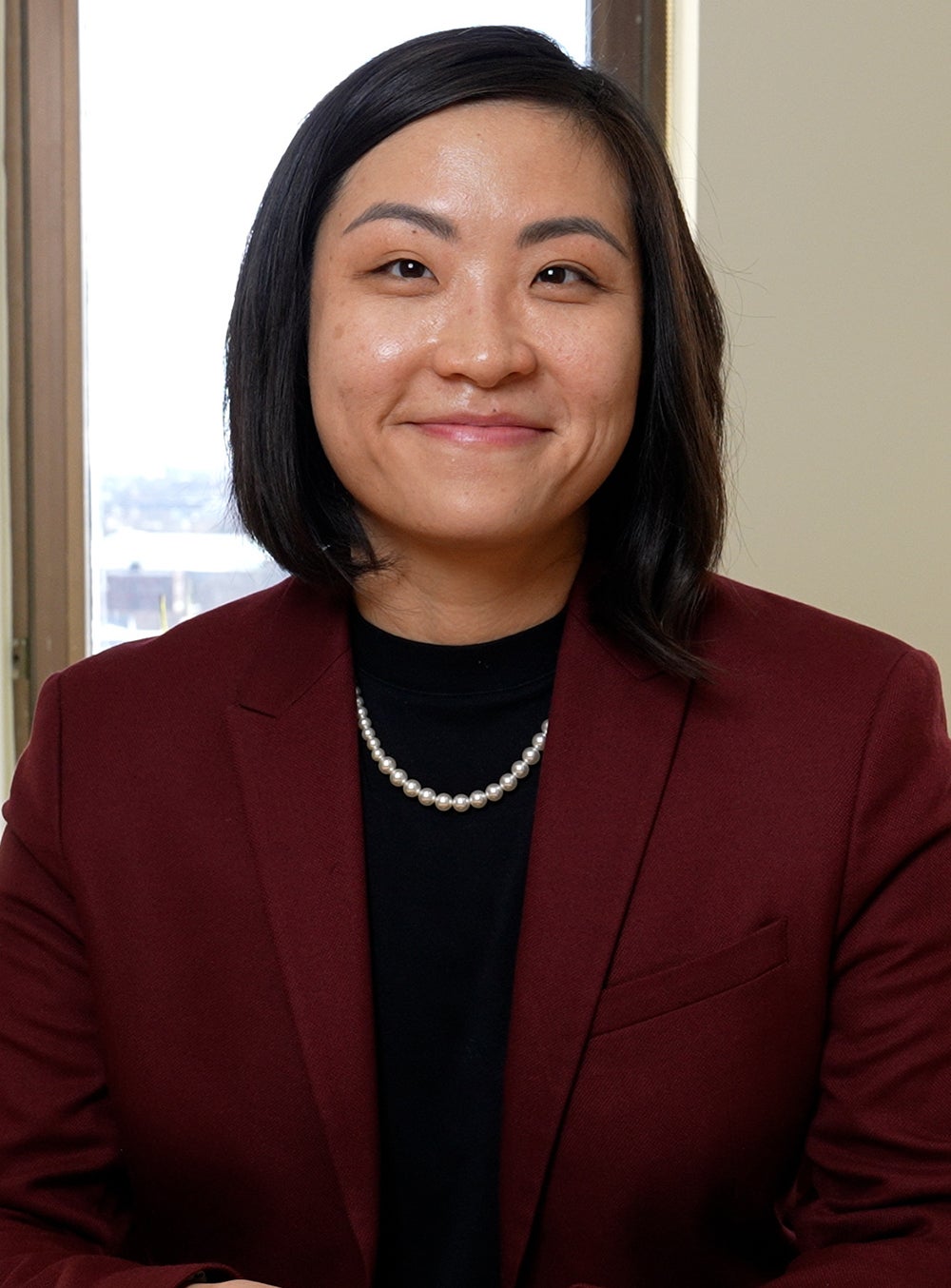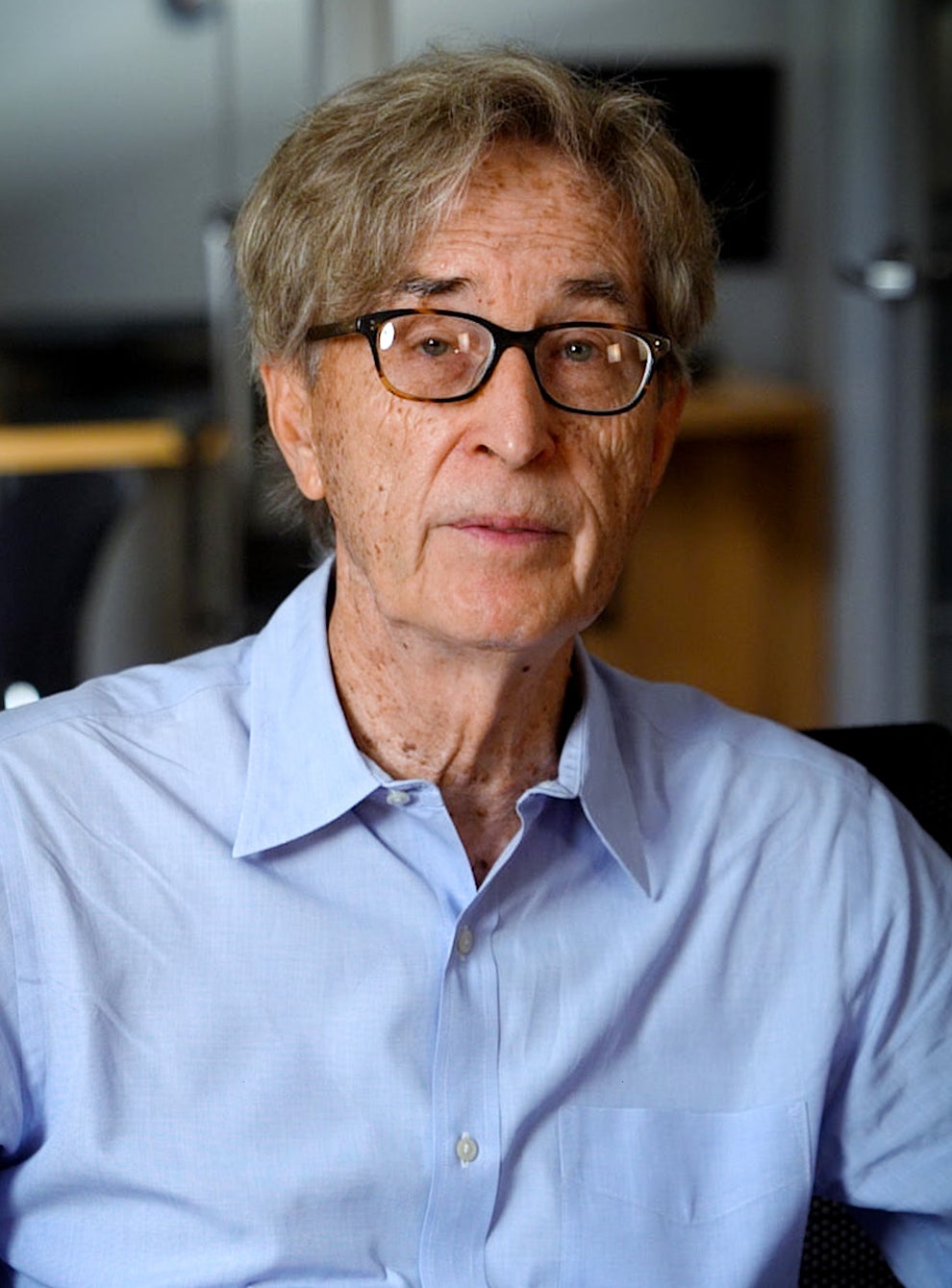
DEVELOPING PUBLIC HEALTH LEADERS IS CENTRAL TO THE HARVARD SCHOOL OF PUBLIC HEALTH'S MISSION. Each year, more than 350 public health professionals earn advanced degrees from the School. While their backgrounds and interests are extraordinarily diverse, all are united by a common desire to make a positive difference in health and well-being of the world's populations. The profiles below highlight just a few of the School's exceptional students and recent graduates, whose drive and enthusiasm for their work are an inspiration to us all.

Unfortunately many of the School's students also share the common burden of working in a field which, while emotionally satisfying, can be economically draining. They make tremendous sacrifices to study at Harvard and pursue careers in public health. For this reason, we are indebted to the generosity of donors like Russell and Judith Carson, John and Virginia Taplin, the Cabot Family, and so many others, who have made gifts to support scholarships and fellowships at the School. In an age of rising academic and housing costs and fierce competition for training grants, their contributions have helped so many gifted scholars attend the School and grow into the public health leaders they were meant to be.


photos: Kent Dayton

HIS RESUME READS LIKE A LAUNDRY LIST OF PUBLIC HEALTH CREDENTIALS. Trained as a medical doctor in his native country of Burkina Faso in Western Africa, Gaston Sorgho worked for 12 years on almost every possible level in his government's health system--from medical officer, to hospital manager, to director of its first national family planning program. From there, he became a health advisor specializing in reproductive health issues, first for an international NGO called Plan International and later for the Dutch Embassy as part of Holland’s West African Health Program. He took only a one-year hiatus in this seven-year professional stint to get his MPH degree from the Royal Tropical Institute in Amsterdam (KIT) and is currently on unpaid leave from the World Bank, where he has been a specialist in public health since 1999. So with this bounty of hands-on public health experience, why return to academia to pursue a DPH at the School? "When you are doing a doctorate, that's when you've been through things,"reflects Sorgho in a rich accent laced with French. "You have worked and now you have some ideas and you want to push them more, so you need to come back." He adds, laughing, "I was surprised to see that in Harvard the students are so young."

Pushing ideas--and himself--to the limit is nothing new for this 45-year-old public health veteran. Even as he dives headlong into required courses like biostatistics ("they are so important but a challenge for me"), Sorgho is champing at the bit to tackle his thesis project, which will address how health sector reform in developing countries has impacted the outcome of reproductive health programs. Now a free agent with professional experience and connections in both government and non-profit, he sees himself as an ideal candidate to bridge the gap between the two in order to design and implement the most effective health policy. But he is not oblivious of the size of the task set before him. "It's huge, it's difficult, but still we need to do it," stresses Sorgho. "Otherwise it doesn't make sense to continue reforming and reforming if we're not going to make a positive difference."

The challenges Sorgho faces at the School are not only conceptual but financial as well. He notes that living in Boston is extremely expensive, particularly when adding in the needs of his wife and two daughters, who followed him here from Burkina Faso. "I have to fight to get enough resources to live with my family," he says, "and being a full-time student, that's not easy." Even with substantial financial aid from the School's Department of Population and International Health and Office of Student Financial Services, for which they are extremely grateful, the Sorghos still had to invest all of their savings for him to come to this country and further his education. However, Sorgho has little doubt that the payoff will be worth all the sacrifice. "First, morally I am very satisfied with what I am doing, and this is very important to me, "he says. "I also think it is very, very important for my family to be here, for my kids to study in the US and for my wife to see another world other than our own country. So all this together I think it makes sense to me, this kind of investment."

After completing his doctorate, Sorgho hopes to import the fruits of his labor back to his homeland to help unravel Burkino Faso's many health sector problems such as women's reproductive rights and AIDS. His dream is to teach public health at the university level in West Africa, where he says the field does not get the attention or quality instruction it deserves. Changes in public health since 9/11 have made this effort even more imperative, Sorgho notes, because developing countries will have to understand that they are not the only ones in need--that perspectives and funding priorities will change with new threats like bioterrorism. "Bioterrorism is the best example to show that international health is more than an issue of resources--it's an issue of problems we all have to face." But convincing his fellow countrymen of the necessity of keeping pace with change and investing time and effort in learning and communication has sometimes been frustrating. "Some are saying that I'm moving too fast, that I'm too ambitious," says Sorgho. "But that’s the only way you can make a difference. Without ambition you are not realizing something important."

next top


photos: top and bottom, Kent Dayton: center, Anderson Ross, Getty Images

IT WAS A VETERINARIAN'S WORST NIGHTMARE: the slaughter of nearly four million innocent animals. In 1997, foot and mouth disease spread across Taiwan like wildfire, forcing the country to destroy a quarter of its hog population and paralyzing what up to then had been a $1.6 billion a year pork export industry. "That was a disaster for us," says Tsz-Pei Wu, who was then working for the Bureau of Animal and Plant Health Inspection and Quarantine, the Taiwanese government's equivalent of the USDA. Armed with a degree in veterinary science and a master's in biomolecular research, Wu was employed by the agency to help develop systems for monitoring and containing animal disease and to negotiate agreements for the trade of animals and animal products between Taiwan and other countries. It seemed the perfect place for her to combine her love of biology and natural science with her growing interest in the intricacies of health policy and systems design. Nevertheless, Wu's medical training made it painful for her to bear witness to so much death. She came to believe that the regulatory process could do with some improving, particularly when future epidemics could pose threats to both animals and people (foot and mouth disease is only rarely transmitted to humans). "We had to kill lots and lots of animals just because one or several cases happened," Wu says haltingly, searching for the right words in English."So I'm thinking if we can make a regulation or survey system, not only for one country but for every country, we can improve the process and reduce the risk of this happening. And then you cannot only protect animal or human health, you can actually protect life."

Receiving support from the Taiwanese Physicians Fund, which provides financial aid for Chinese students studying public health at the School, Wu came to Boston to bring her administrative and management skills up to the level of her clinical expertise. An added bonus would be to bolster her foreign language proficiency, which she says has become increasingly critical in international policy negotiation. Citing the School's quantitative strengths, Wu has become particularly charmed by the subject of risk analysis and its potential applications to her field. She says that the systematic and meticulous approach to weighing risks and making decisions as it is taught here in the US could revolutionize the way Taiwan and other countries design import/export policies to contain diseases across borders. "If you don’t have the scientific evidence or proof," Wu observes, "they can say there’s no such risk and you get stuck and you cannot communicate." Risk analysis, however, puts that evidence right in your hands, she says, so you can set rules that are reasonable.

While Wu has been thrilled with her educational experience here thus far, she also admits that it has been somewhat of a culture shock. Her English language skills, she concedes, need some polishing and, like many other international students at the School, she is sometimes perplexed by the political and cultural workings of US systems, upon which many academic courses are based. But Wu can't understand anyone who isn't up for such challenges. "I think many people would say that Harvard is the best school and they are not good enough to enroll here," she says, her whispery voice slowly rising above the din of students in the FXB lobby. "But if you think you are not so good, then you don't try and you don't have the opportunity. So I would encourage anyone if you think something is important, you should try and do something about it." So what does Wu think is important enough for her to pursue? While she would like to stay at the School longer to explore her fascination with risk analysis, ultimately Wu intends to return to her work in Taiwan. She declares that she would like to eventually become the head of her agency--to be that one final decision-maker in the animal disease regulatory process for Taiwan. Despite her soft-spoken demeanor, her resolve is unmistakable, so much that one cannot help but believe she'll succeed. "When you are faced with something new, and it challenges you, but you realize it's important so you have to go for it to achieve that goal--I like that process," she smiles. "I feel trying makes me very happy."

top next


photos: top, Kent Dayton; bottom, ©Photodisc, Inc.

SUSAN GRECO KNOWS A LITTLE SOMETHING ABOUT AIR POLLUTION. After all, in her native Ontario, it costs the health care system and economy more than $1 billion each year. But nothing prepared Greco for what she witnessed firsthand in Beijing, where she traveled last summer to lecture at a workshop on health and the environment. "It was the most polluted place I'd ever been," says the bubbly doctoral candidate in environmental health. "It's just air pollution on a completely different scale." But Greco's first foray to China's 'breathtaking' capital city has only made her more committed to her current research endeavor, a joint effort between her department at the School and the Harvard University Center for the Environment’s China Project. This year, she will try to devise methods for estimating the health effects of air pollution from motor vehicles, a mounting problem in Beijing and other cities in the developing world, where high emissions combined with exceptionally confined spaces can result in elevated levels of exposure. The China Project aims to use research like Greco's to ensure that a rapidly industrializing country of 1.3 billion people makes policy decisions to sustain development without destroying their own environment. But ultimately, says Greco, it could have applications to "just about anywhere that has cars."

Greco's route to environmental health could be called rationally circuitous. A math and science whiz as a teen, she pursued engineering as the most logical calling. But once armed with bachelor's and master's degrees, Greco found the traditional engineering career path to be somewhat uninspiring. "If anyone had told me a couple of years ago they were thinking of going into engineering, I would have told them to run," she laughs. "But in hindsight, my engineering background has helped me a lot." Always intrigued with environmental engineering, which is essentially a blend of the mechanical, chemical, and civil components of her field with a focus on air and water quality issues, Greco began exploring other professional options that would incorporate her love for technical problem-solving with her growing interest in the health impact of the environment. A brief email correspondence with Jack Spengler in the Department of Environmental Health (who was coincidentally doing air pollution studies up in Canada) sealed her fate--she was hooked.

While the environment can encompass so many different elements, the air we breathe is what appeals most to Greco. "Air is just so ubiquitous," she notes with just a touch of admiration. "Even water, which travels all over, is not of the same magnitude. And there are so many interesting things about it: transboundary issues, how it travels, how it's confined by buildings. And definitely the exercising thing was a big part of my interest too." The exercising thing is Greco's passion for running. An avid runner in college, she become captain of her cross-country and track teams in graduate school. This health-conscious athleticism has only reinforced for her the importance of air quality on the body's optimal performance. So now that she's in Boston, is a marathon in Greco's future? Certainly not this year, she says, what with being a resident community advisor at the Shattuck International House and her heavy course load--a marked change from her previous graduate school experience. "I'm confident that if I trained I could finish, but I wouldn't want to do one unless I was prepared to run fast, do my best."

This deliberate attitude toward decision-making is something that spills over into every aspect of Greco's life. It was a serious decision to switch career paths. It was a serious decision to venture down to the United States to continue her education. Between a lower cost of living and the weak Canadian dollar, it certainly would have been less expensive in her homeland. But armed with financial aid from a variety of sources including the Canadian government’s NSERC scholarships, the Les Silverman Fund, and the Pew Charitable Trusts, Greco has never looked back. She observes that within a two minute walk from her desk at Landmark Center she can find at least 20 experts working on the health effects of air pollution, a resource she’d be hard pressed to find anywhere else but the School. "I'm sure I would have had a good experience in Canada," she reflects, "but I would never have had Harvard's equal."

top next


Be it through clinical practice or TV spots for his local branch of Telemundo, Nieves is all about reaching the traditionally underserved in his community of Hartford, CT (above).

photos: Kent Dayton


RAISED BY WORKING-CLASS PARENTS IN CONNECTICUT, Julian Nieves remembers going to the local hospital clinic as a child, his footsteps tracing the "red line" that directs patients to different medical services. "We fell into that specific area where we were not poor enough to receive aid but at the same time not rich enough for insurance," he recalls. "I remember how it was, and I always felt that I could be a part of that environment and a part of improving it." Nieves stayed true to his childhood ambitions. After earning his MD from Cornell's medical school in New York City and completing his residency at Yale, he decided to begin his career close to home, practicing primary care medicine at Hartford Hospital. Serving a predominantly inner-city patient population, Nieves became intent on improving the delivery of health care to the traditionally underserved. "It was good to go back to my community, become part of the place that helped get me where I am, and give back a bit," he says.

To reach his community most effectively, Nieves donned a variety of professional hats, from doctor to administrator to educator. In addition to his internist responsibilities, he became the medical director of one of Hartford Hospital's outpatient clinics and an assistant professor at the University of Connecticut. "It was interesting because I was taught, and was in the role of teaching others, to apply the evidence-based, patient-centered model of medicine," he reflects, "but at the same time I saw the reality of the finances and politics of administration--and sometimes they’re just not congruent." Nieves's position at the clinic became double-edged. On the one hand, he was extremely proud to be at the helm of an urban outpatient center, where he could shape its systems to best meet the needs of its constituency. On the other, he found that economic and bureaucratic pressures put a limit on what he could do--that he was always working with the threat of the ax above his head. He wanted to find a way to wield that ax himself. "Well, not hold the ax literally," Nieves laughs, "but be in control instead of being controlled. Unfortunately the health care industry is a business. Instead of trying to fight it, I'm just trying to work with it."

Finding himself walking this tightrope between medicine and management, Nieves decided that he needed to gain more skills to operate effectively. After exploring a number of academic options including MBA programs, he decided that an MPH offered the optimal way for him to master the intricacies of health management, policy, and finance. “In the end, Harvard was the ideal choice because it incorporated everything I was looking for in a program,” he says. The fact that he was awarded the Commonwealth Fund/Harvard University Fellowship in Minority Health Policy didn't hurt either. This interdisciplinary, University-wide fellowship is designed to train physicians in the fundamental sciences of public health, with an emphasis on leadership and minority health issues.

Where this latest academic experience will ultimately lead, Nieves still doesn't know. "There are so many avenues that one can take with regard to effecting change in health care service delivery," he says, tossing out the examples of government, administration, non-profit, and medicine. And Nieves hasn’t ruled out private industry. He became intrigued with the role of free enterprise in health when he partnered with Pfizer Pharmaceuticals back in Hartford to bring his own "baby idea" to fruition. With Pfizer's support, he produced a series of public health messages for his local branch of the Telemundo, a Spanish-language television channel that reaches an audience of about 400,000 in central Connecticut and Western Massachusetts. Each week, the bilingual Nieves played host to the short health-related clips, which aired during the station's main newscast on different health issues such as diet, cancer, and HIV, and at the start of the school year he was still popping down to Connecticut to finish up filming.

But whether he succumbs to the lure of the public or private, Nieves is sure to apply his School experience to breaking down barriers in health care, striving to ensure that everyone is on equal playing ground when it comes to health issues. The indiscriminate loss of life on 9/11--insured or uninsured, rich or poor, young or old--was proof of our common vulnerability, he declares. "We've got to take care of each other, now more than ever, and public health is in the business of taking care of people."

top next


photos: top, Kent Dayton; bottom, Photodisc, Inc. Getty Images

WHEN ELLA OONG SAYS SHE'S "A LITTLE BUSY" THESE DAYS, she's living proof that such expressions are all relative. Even hearing her run through the list of her current responsibilities is exhausting. With a DMD from Tufts Dental School and an MPH from the Harvard School of Public Health under her belt, Oong has now embarked on a combined general practice and public health residency at the Montefiore Medical Center, the primary teaching hospital for the Albert Einstein College of Medicine in New York. But that's just the tip of the iceberg. From establishing dental health services at a homeless shelter, to performing dental screenings on middle school students, to surveying high schoolers about their knowledge and practice of oral health, Oong has had an impact on the dental health needs of virtually every age group in her newly adopted community. She has also helped manage a clinical research training program for dental students from Howard University, to give them hands-on exposure to public health staples like epidemiology and biostatistics. And although her emergncy on-call duties at Jacobi Medical Center may keep her up at night, it hasn't stopped Oong from receiving a grant to develop a media plan and public service announcements for the Oral Cancer Consortium of New York. It hasn't rid her of any modesty either. "Oh, I'm just out here in the Bronx making a very, very small mark," she laughs.

Oong's path to the Bronx began on the opposite coast in Los Angeles, where she grew up the daughter of a traditional family dentist. Her love for working with her hands made Oong a natural candidate to follow in her father's footsteps, but the lure of public health was undeniable. After working as a community HIV educator for three years, she applied to Tufts Dental, where she received a Schweitzer Fellowship to assess the oral health needs of domestic violence victims living in homeless shelters. "People don't necessarily picture dentistry as part of public health, involved with such things as shelter settings or domestic violence," says Oong. "But oral health is part of your health as a whole, and it's important to have a balanced perspective." With the encouragement of her dental school advisors, both HSPH graduates themselves, Oong pursued her MPH at the School to acquire the skills for putting her clinical expertise into action. She is nothing but pleased with the results, noting that much of the experience she took away from graduation last May is now coming into play in real life. "I find myself so completely prepared for any issue that comes along, from domestic violence to oral health care legislation," she declares.

Oong notes that she has financial aid to thank for allowing her to take full advantage of all the School had to offer, from after-hours lectures to cross-registration with other parts of the University. Without it, given all the dental school loans on her back, Oong certainly couldn't have attended without taking on a time-encroaching job. More likely, she would have delayed or pursued her public health career without a formal degree because, as she points out, there's not only the cost of tuition to consider but the lost income that comes with choosing public health over private practice. Oong was particularly invigorated by the opportunity scholarship support gave her to do cross-disciplinary work. "You get sort of a meeting of the minds, learning what skills medicine, social services, and educators have to offer each other," she says. "To work in that kind of setting is really exciting. And that’s the way reality is--you’re not going to be isolated in your own little field."

Oong is hardly isolated from the real world, though her ebullient nature belies the sometimes-grueling nature of her job. There's the five-year-old with the untreated open cleft palate. Or the 12-year-old with a papilloma lesion on the posterior soft palate, a possible indicator of sexually transmitted disease. "It's tough work," admits Oong. "I can show you rampant caries of the kind that you would find in developing countries. I see malnutrition, craniofacial anomalies, all of that, here in the States." But this hardly dampens her enthusiasm. Oong notes that even another opportunity at her much-missed alma mater would be hard-pressed to draw her away from her work right now. In the meantime, she hopes to continue infusing a bit of the School into everything she does. "People have told me that you can bring a little Harvard into wherever you go," Oong remarks, "bring not only the knowledge but everything that comes from a degree, but also from the skills, the training, and the resources--everything to make a connection with your community." She's on her way to proving them absolutely right.

top next


photo: Kris Snibbe, Harvard University News Office

DONALD WARNE IS WELL AWARE THAT THE SCALES ARE TIPPED against Native American health. The traditional medicine of the Lakota, a branch of Plains Indian tribes clustered in the north-central United States, maintains that wellness can be achieved only when the kindred forces of the mind, body, and spirit are balanced in a unified way. Descended from a long line of Lakota tribal healers in Pine Ridge, S.D., Warne was raised to embrace this concept of equilibrium but believes that discounting its importance has not only led to the diminished health of individual Native Americans but is an underlying flaw of their health care system overall. "What's missing is that health policy in Indian country does not reflect the cultural holism that is a fundamental part of traditional medicine and belief," he says. "That's part of the reason why we haven't been successful at improving the health status of the Native American people." And improved health status is what Native Americans desperately need. As a group, they die at unprecedented rates from diseases like diabetes, tuberculosis, alcoholism, and depression, which can plunge their life expectancy almost 20 years below that of the average American. "It's very easy to see where we're missing opportunities to incorporate traditional concepts into modern medicine and public health," Warne observes.

The marriage of tradition and innovation to improve health is nothing new to Warne. Already a Lakota pejuta wicasa, or medicine man, he pursued his modern medical training always on the lookout for productive ways to combine the two. Armed with a medical degree from Stanford University, Warne underwent formal training in a wide range of alternative healing techniques, including acupuncture, homeopathy, and botanical medicine, and in 1998 began to put his integrative approaches to work in the clinics of an Indian reservation just south of Phoenix, Ariz. His victories were meaningful but small and hard won. He found that as a field clinician there were limits to what he could do because priorities developed at the federal level were often inconsistent with the culture on the ground. "The problem is on a bigger scale because the system doesn't work effectively," says Warne, "and to take the next step to create a healing environment in the system of Indian health, I knew I needed training in public health."

Warne says he found exactly what he was looking for at the School. Courses in unfamiliar but undeniably germane subjects such as mobilizing communities, designing intervention programs, health services research, and political strategy were all there for the taking. But an exceptional academic experience notwithstanding, Warne is quick to mention one real perk that came with his degree last May: Harvard's reputation. He’s not being cynical, just pragmatic. "If I were just a traditional Native person trying to talk to policymakers, it would be a lot harder," says Warne. "But with a Stanford MD or a Harvard MPH--they just simply open doors." Of course, no academic degree can erase all the obstacles inherent to a public health career. Warne sees all the hurdles ahead of him, from an entrenched over-reliance on allopathic medicine to the cultural naivete of agencies working with Native Americans. But he believes traditional values that place the needs of the group over those of the individual are the key to any public health success. "It's not easy," he says earnestly. "It requires a lot of work. It requires getting into a lot of debt. It requires sacrifice. So if it's just about you or developing a successful career, then don't even bother, do something else. But if it's about improving your community, there's your motivation, that's what will keep you going through the challenges."

Warne's motivation is clear. Now back outside Phoenix, with his clinical obligations down to one day a week, he is focused on the broader picture, trying to develop more balanced and culturally appropriate health policies and programs for Native Americans. In particular, he is leading an effort with the National Institutes of Health to design community-based interventions to prevent and treat diabetes, which is running rampant through Arizona's American Indian population. Despite overwhelming odds, Warne is encouraged by prospect of creating meaningful relationships in Native American health care: "What I'm finding is that policy people seem to have a genuine interest and commitment to this effort. And clearly the traditional Native people want to see their health improve. So it’s an opportunity to bring together two worlds that have typically not shared the same space." Warne notes that this meeting of the minds is not something that will happen overnight, that it will take years of building alliances, developing policy, and influencing politics to improve funding and reduce health disparities. But Warne plans to be there every step of the way. "Making a positive impact on Indian health," he reflects, "that's going to be a life-long journey."

top

©2003 Harvard School of Public Health, Office for Resource Development

contact webmaster