



Engineering Methods for the Control of Airborne Infections:
An International Perspective
July 14–25, 2008
Boston, Massachusetts
Register for 2008
Download the 2008 Brochure
Scholarships Available!
Lectures and laboratory workshops are designed to equip engineers from around the world with the technical skills and methods used to control infections that are predominantly or partially airborne.
Program Highlights
- Hands on laboratory and problem solving workshops assure that concepts are thoroughly mastered and can be applied in practice
- Case-based group problem solving sessions prepare participants working in resource poor regions to improvise creatively
- Learn from an experienced faculty of leading academics and professionals
- Ready-made materials are provided to assist participants in the preparation of their own instruction courses
Educational Support Provided in Part By
World Health Organization
Center for Disease Control and Prevention
National Institute of Health
Who Should Attend
- Professional engineers
- Architects
- Health and safety specialists
- International health workers
- Government agency employees
- Relief and response teams
- Academics
Program Overview
This two week, multi disciplinary continuing education course is globally unique in that it brings together a body of technical expertise common to the control of human airborne infections. These include tuberculosis (including drug resistant strains), pandemic influenza, SARS, and selected bioterrorism agents.
Control strategies will range from mechanical ventilation, filtration, and the design and use of space, to the proper application of germicidal UV air disinfection and natural ventilation. The course will include didactic lectures, laboratory sessions, and interactive workshops focusing on problem solving in both resource-rich and resource-limited settings.
The strategies covered will be applicable to preventing transmission in workplaces, including clinics, hospitals, laboratories, and congregate living settings. Experienced faculty will be drawn from Harvard, Centers for Disease Control and Prevention, National Institutes of Health, and other domestic and international sources.
Upon Completion Of This Program,
Participants Will Be Able To Plan and Assess
- Engineering interventions and outbreak preparedness, in the context of a comprehensive infection control plan for tuberculosis, influenza, SARS, and select airborne bioterrorism agents
- Optimal utilization of available indoor space, including laboratory design to reduce airborne transmission, protecting workers, and specimens
- Natural and mechanical ventilation, engineering interventions-filtration, UV, and the proper function of biological safety cabinets
- How to recommend and fit test personal respiratory protection
- Bioaerosol behavior in indoor spaces, effects of humidity, sunlight, and other factors
- Directional airflow: design and measurement of relative room pressures for isolation
- Air filtration in-duct and free-standing room air disinfection units: use, selection, limitations, and maintenance
- Ultraviolet (UV) air disinfection: theory, system design, fixtures, UV measurement, safety, limitations, and maintenance. Upper room versus UV in ducts or room air-moving devices
- Hospital design and space utilization for optimal control of airborne infections
- Local ventilation: booths and rooms for sputum collection, bronchoscopy, and other high-risk procedures
Faculty Members
Course Co-Coordinators:
Melvin W. First, ScD, CIH, PE
Professor of Environmental Health Engineering, Emeritus
Exposure, Epidemiology and Risk Program
Department of Environmental Health
Harvard School of Public Health
Paul A. Jensen, PhD, PE, CIH
Captain, U.S. Public Health Service
Engineer Director
Division of Tuberculosis Elimination (DTBE)
National Center for HIV, STD, and TB Prevention (NCHSTP)
Centers for Disease Control and Prevention (CDC)
Edward A. Nardell, MD
Associate Professor
Harvard Medical School
Harvard School of Public Health
Partners in Health, Brigham and Women’s Hospital
Division of Social Medicine and Health Inequalities
Faculty:
Janet S. Baum, BS, Master of Architecture, AIA
Laboratory Architect
Health, Education, & Research Associates
Jean P. Khoshbin, RA
Program Officer, Office of Biodefense Research Affairs
Division of Microbiology and Infectious Diseases
National Institute of Allergy and Infectious Diseases
National Institutes of Health.
Gary Zackowitz, RA
Office of Biodefense Research Affairs
Division of Microbiology and Infectious Diseases
National Institute of Allergy and Infectious Diseases
National Institutes of Health
Babak Farahpour, PE
Office of Biodefense Research Affairs
Division of Microbiology and Infectious Diseases
National Institute of Allergy and Infectious Diseases
National Institutes of Health
Stephen N. Rudnick, MS, ScD, CIH
Lecturer on Industrial Hygiene Engineering
Department of Environmental Health
Harvard School of Public Health
International panel of guest faculty to be announced
Agenda
| Monday, July 14, 2008 | |
| 7:30 am | Registration and Continental Breakfast |
| 8:00 | Overview of Course and Introductions – First |
| 9:00 | Overview of Airborne Infections and Control Strategies – Nardell |
| 10:15 | Break |
| 10:30 | Introduction to Bioaerosols and Their Dynamic Properties – First |
| 12:00 pm | Lunch |
| 1:00 | Ventilation: Basic Concepts of System Design – Price |
| 3:00 | Break |
| 3:15 | Ventilation: Airflow Measuring Instruments – Price |
| 4:15 | Ventilation: Hands-on Airflow Measurement Seminar – Price/Rudnick |
| 5:30 | Sessions End / Welcome Reception for Participants and Faculty |
| Tuesday, July 15, 2008 | |
| 7:30 am | Continental Breakfast |
| 8:00 | Ventilation: Room Pressure Differentials and Airflow Patterns; Double-Door Entries – First |
| 9:00 | Ventilation: Measuring Air Currents and Pressure Differentials – Price |
| 10:00 | Break |
| 10:15 | Ventilation Lab: Measuring Ventilation Flow Directions and Pressure Differentials – Rudnick/Price |
| 12:00 pm | Lunch |
| 1:00 | Exhaust Ventilation Systems for Labs and Health Care Facilities – DiBerardinis |
| 2:15 | Ventilation Lab at Northeastern University – Rudnick/Price |
| 5:00 | Sessions End |
| Wednesday, July 16, 2008 | |
| 7:30 am | Continental Breakfast |
| 8:00 | Intervention: Ultraviolet Germicidal Irradiation (UVGI): History and Theory of Efficacy – Nardell |
| 9:00 | Intervention: UVGI in Ventilation Ducts and in Recalculating Room Air Disinfection Units – Rudnick |
| 10:00 | Break |
| 10:15 | Intervention: Upper-room UVGI: Theory of Application, Equipment Types and Their Emission Characteristics, Applications – Vincent |
| 12:00 pm | Lunch |
| 1:00 | Intervention: UVGI Equipment: Maintenance & Repair – Rudnick |
| 2:00 | UVGI Radiometers and Their Use for Upper and Lower Room Measurements – Rudnick |
| 3:15 | Break |
| 3:30 | UVGI Measurement Lab – Rudnick |
| 5:00 |
Sessions End |
| Thursday, July 17, 2008 | |
| 7:30 am | Continental Breakfast |
| 8:00 | Intervention: Design of Upper-room UVGI Systems, CAD Design Aid – Nardell/Ngai |
| 10:00 | Break |
| 10:15 | HEPA Filters and Ventilation Filters: Filtration Theory – First |
| 12:00 pm | Lunch |
| 1:00 | Intervention: Free-standing Air-recirculating Room Filtration Units, ESP, etc.: Applications, Effectiveness – Rudnick |
| 2:30 | Break |
| 2:45 | HEPA Filter Testing Lab at Northeastern University – Price/Rudnick |
| 5:00 | Sessions End |
| Friday, July 18, 2008 | |
| 7:30 am | Continental Breakfast |
| 8:00 | Tuberculosis: A Model Airborne Infection – Nardell |
| 9:00 | Tuberculosis: CDC and International Guidelines Overview – Jensen |
| 10:00 | Break |
| 10:15 | Influenza and Other Viral Illnesses – Milton |
| 12:00 pm | Lunch |
| 1:00 | Bioterrorism Agents: Agent Introduction & Neutralization – Rodonovitch |
| 3:00 | Break |
| 3:15 | Intervention: Face Masks and Respirators: Protection Factors, Selection, Fit Testing Comfort, Speech Recognition, Respirator Demonstrations and Try-ons – Rodonovitch |
| 5:00 | Respirators in Resource Limited Settings – Nardell |
| 5:30 | Sessions End |
| Weekend off to enjoy Boston and environs | |
| Monday, July 21, 2008 | |
| 7:30 am | Continental Breakfast |
| 8:00 | Intervention: Lecture, Natural Ventilation of Healthcare Facilities and Measuring ACH with CO2 – Escombe |
| 9:30 | Break |
| 9:45 | Ventilation: Lab: Measuring ACH with CO2 – James |
| 12:00 pm | Lunch |
| 1:00 | Seminar: Special Aspects of Hot, Moderate, and Cold Climates on Ventilating Facilities – Faculty |
| 3:00 | Break |
| 3:15 | Fans, Exhaust Stacks, and Avoidance of Exhaust Gas Reentrainment – Seth |
| 4:15 | Commissioning the Facility – Seth |
| 5:30 | Sessions End |
| Tuesday, July 22, 2008 | |
| 7:30 am | Continental Breakfast |
| 8:00 | Design and Maintenance of Hospitals and Other Healthcare Facilities to Minimize Airborne Disease Transmission – Parsons |
| 10:00 | Break |
| 10:15 | Hospital Design (Continued): Facilities for Sputum Collection – Parsons/Jensen |
| 12:00 pm | Lunch |
| 1:00 | Workshop: Designing Healthcare Facilities Under Conditions of Limited Recourses – Volchenkov/Parsons/Escombe/Jensen |
| 3:00 | Break |
| 3:15 | Hospital Visits to Observe Facilities Including UVGI – Faculty |
| 5:30 | Sessions End |
| Wednesday, July 23, 2008 | |
| 7:30 am | Continental Breakfast |
| 8:00 | Laboratory Design: Health and Safety Considerations – Baum |
| 10:00 | Break |
| 10:15 | Laboratory Design (Continued) – Baum |
| 11:15 | Green Laboratories – Beaudoin |
| 12:15 pm | Lunch |
| 1:00 | Laboratory Containment and Security – Khoshbin |
| 3:00 | Break |
| 3:15 | Laboratory containment and security (Continued) – Zockowitz |
| 5:00 | Laboratory Visits – Faculty |
| 6:00 | Sessions End |
| Thursday, July 24, 2008 | |
| 7:30 am | Continental Breakfast |
| 8:00 | Decommissioning, Decontaminating, and Reconstructing Old Laboratories – Baum |
| 9:45 | Refreshment Break |
| 10:00 | Seminar: Problem Solving: Prisons, Shelters, and Other Challenging Settings – Volchenkov/Parsons/Escombe/Jensen |
| 12:00 pm | Lunch |
| 1:00 | Seminar: Semi-Structured Discussion Between Faculty and Attendees: Current Issues Associated with Airborne Disease Transmission and the Ability of Architects and Engineers to Help Meet these Challenging Needs (session ends when all issues are vented and exhausted). |
| Friday, July 25, 2008 | |
| 7:30 am | All day field trip to the Baker Company (Biological Safety Cabinets) – Stanford, Maine. Topics include: Theory, Selection, and Maintenance and Certification of Biological Safety Cabinets (sponsored by the Eagleston Institute) |
| 5:00 pm | Farewell Banquet (how to deconstruct a Maine lobster) and Award of Certificates |
| Agenda subject to change | |
| Special thanks is due to The Baker Company and the Eagleston Institute for their generous support of this program. | |
Continuing Education Credit
The Harvard School of Public Health is accredited by the Accreditation Council for Continuing Medical Education to provide continuing medical education for physicians. The Harvard School of Public Health designates this educational activity for a maximum of 78 AMA PRA Category 1 Credit(s)™. Physicians should only claim credit commensurate with the extent of their participation in the activity.
- 7.8 CEUs, Harvard School of Public Health
- 32 CECs, American Academy of Health Physics
- 10.0 Industrial Hygiene CM Points, American Board of Industrial Hygiene
- American Academy of Health Physics (AAHP) credits (amount pending)
- The Center for Continuing Professional Education is a registered provider of the American Institute of Architects. This program has been designated for AIA/HSW learning units (amount pending).
The Harvard School of Public Health has an Education and Research Center (ERC) that is funded by the National Institute for Occupational Safety and Health (NIOSH).
Program Check-In
On the first day, please check in at:
Harvard School of Public Health
Kresge Building
677 Huntington Avenue
Boston, Massachusetts 02115
617-384-8692
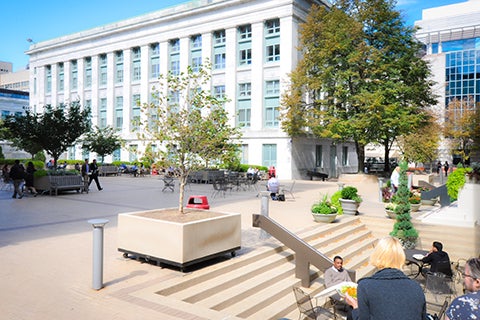
The program takes place at the Harvard School of Public Health, located in the heart of the Harvard Longwood Campus in Boston. Public transportation is also readily available to the city's many shopping districts, museums and restaurants. For directions, please visit: the Longwood Campus directions page.
Accommodations
Dorm space is available for participants at a rate of $50 per night.
Program Fee
$4,500 if payment received by July 7, 2008
$4,600 if payment received after July 7, 2008
Please do not invest in non-refundable airline tickets until you have received confirmation from us on May 14, 2008 regarding the program status.
Program fee includes:
- Comprehensive take-home reference manual
- Continental breakfasts, lunches, and refreshment breaks
- CME and CEU credits
- Harvard School of Public Health certificate of attendance
- Field trip to Maine with group photo and farewell reception
Scholarships
A limited number of partial and full scholarships may be available for this program. If you wish to request a scholarship, please apply online at http://www.hsph.harvard.edu/ccpe/HTML-reg-forms/AIRreg.html. Please include the following information in your application (You can also fill out this information in the online registration form):
1. Job title, organization, and duties
2. How you expect the information provided in this program will benefit your organization
3. Amount of program fee your employer can support
There is a non-refundable $50 co-pay for all recipients of full scholarships.
Payment Policy
Payment must be made in U.S. funds and received in order to process your registration. Payment by credit card is strongly preferred (Visa, MasterCard, AmEx). If paying by check, please make check payable to Harvard School of Public Health-CCPE. Space is limited. Please do not invest in non-refundable airline tickets until you have received confirmation from us on May 14, 2008 regarding the program status.
Substitution/Cancellation Policy
Substitutions may be made without additional charge. All requests for substitutions or cancellations must be made in writing. Cancellation on or before May 23, 2008 will be issued a refund less $150 administrative fee per person. Cancellations received between May 24, 2008 and June 20, 2008 will be issued a refund of 50%. After June 20, 2008, no refund will be issued. There will be no exceptions to this policy.
Ways to Register
- To register online simply check off the items below and click Register Now.
- Call 617-384-8692 and register over the phone. You may also call this number for any registration questions you may have.
- Print the PDF Registration Form and fax it to 617-384-8690 with credit card information.
- You may also fill out, print and mail the form with payment to:
Harvard School of Public Health
Center for Continuing Professional Education
CCPE – Dept. A
677 Huntington Avenue
Boston, MA 02115(If you are planning on sending an overnight package, please send to this address.)
Apply for a scholarship today!