- This event has passed.
Nowhere Apparent: Arts, Activism, and Policymaking with Jack Ferver
February 15th @ 5:00 pm - 6:30 pm
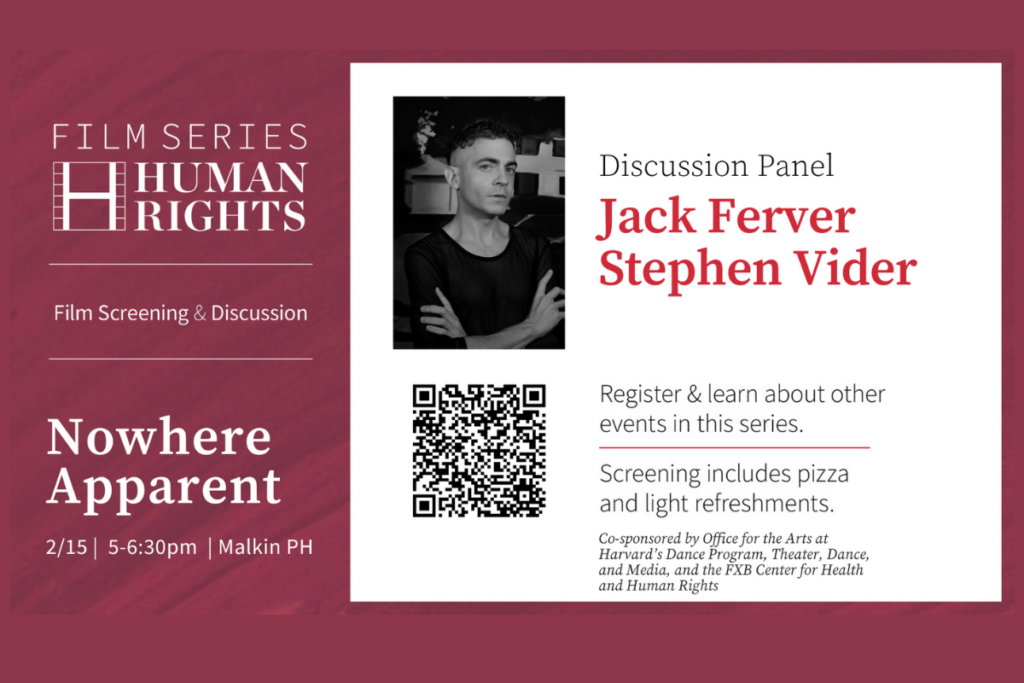
Part of a two-day engagement with Jack Ferver co-presented by the Carr Center for Human Rights Policy at Harvard Kennedy School and the Office for the Arts at Harvard Dance Program, in partnership with Theater, Dance & Media. For information and to register for the movement workshop on February 16 visit: ofa.fas.harvard.edu/dance
Date and Time: Thursday, February 15, 2024, 5:00pm – 6:30pm EST
Location: Malkin Penthouse, Harvard Kennedy School, 79 John F. Kennedy Street, Cambridge, MA 02138
Preregistration for this event is required. This event is co-sponsored by the Office for the Arts at Harvard’s Dance Program and the FXB Center for Health and Human Rights at Harvard University.
Event Description: Register to attend a film screening of Jack Ferver’s film, Nowhere Apparent, followed by a discussion with Stephen Vider about the impact of the AIDS Crisis on the cultural landscape in America. In the 1980s and 1990s, AIDS removed a huge swath of civilians, artists, writers, educators, and leaders. While AIDS affected everyone, the Crisis effectively wiped out a generation of gay men in the U.S. The Crisis had deep implications for generational ties in the gay community, as well as education and culture at large. Ferver’s film explores this and the ongoing need to build community and culture after this generational loss.
Following the film, Ferver will be joined by Professor Stephen Vider (UConn), and together they will explore the potential of the arts, activism, and the archive on policymaking and community building.
Film Description: Nowhere Apparent is a dance film by Jeremy Jacob starring Jack Ferver that creates a world of queer isolation, theatricality, and abandonment in response to disappeared parental figures and the failed response to the AIDS crisis. The version of the film screened for this event is made specifically for academic purposes, using footage from Ferver and Jacob’s research at the AIDS Oral History Project at the New York Public Library of the Performing Arts.
Speakers:
Jack Ferver is a New York–based writer, choreographer, and director. Ferver’s “darkly humorous” (New York Times) works interrogate and indict an array of psychological and sociopolitical issues, particularly in the realms of gender, sexual orientation, and power struggles. Domestically and internationally, Ferver has been presented by the Richard B. Fisher Center for the Performing Arts at Bard College; American Dance Institute (Maryland); Chicago Department of Cultural Affairs and Special Events (Illinois); Portland Institute of Contemporary Art (Oregon); Institute of Contemporary Art at MECA (Maine); Institute of Contemporary Art (Massachusetts); Diverse Works in collaboration with the Contemporary Arts Museum of Houston; and Théâtre de Vanves (France). Their work has been critically acclaimed in the New York Times, La Monde, Village Voice, and ArtsJournal among others. They have been awarded residencies and fellowships from the Maggie Allesee National Center of Choreography at Florida State (2012); Baryshnikov Arts Center (2013); Watermill Center (2014); Institute of Contemporary Art at Maine College of Art (2014); and Live Arts Bard, the commissioning and residency program of The Richard B. Fisher Center for the Performing Arts at Bard College (2014); and Abrons Art Center (2014-2015). They are a 2016 recipient of the Foundation for Contemporary Arts Grant. Ferver teaches at Bard College in the Theater and Performance Program and for the graduate Vocal Arts Program. They have also taught at NYU Tisch, SUNY Purchase, and have set choreography at The Juilliard School. As an actor they have appeared in numerous films and television series and plays.
Stephen Vider is Associate Professor of History at the University of Connecticut and was the founding director of the Public History Initiative at Cornell University. His research examines the social practices and politics of everyday life in the 20th century United States, with a focus on intersections of gender, sexuality, race, and ethnicity. His book, The Queerness of Home: Gender, Sexuality, and the Politics of Domesticity After World War II (University of Chicago Press, 2021), traces how American conceptions of the home have shaped LGBTQ relationships and politics from 1945 to the present. Vider has also contributed to a range of public history projects. At the Museum of the City of New York, he curated the exhibition AIDS at Home: Art and Everyday Activism (May to October 2017), exploring how activists and artists have mobilized domestic space and redefined family in response to HIV/AIDS, from the 1980s to the present. A Place in the City, a short film he co-directed with Nate Lavey for the exhibition, has since been featured in film festivals and programs in New York, Los Angeles, Toronto, and Istanbul. Vider was also co-curator of the exhibition Gay Gotham: Art and Underground Culture in New York (October 2016 to February 2017) and co-author of an accompanying book, a Lambda Literary Award finalist. He has also published essays in the New York Times, Avidly, Time, and Slate, among other places. Prior to teaching at Cornell, Vider was a Visiting Assistant Professor at Bryn Mawr College and a postdoctoral fellow in the history of sexuality at Yale University.
Malkin Penthouse is accessible for wheelchairs and other mobility devices. If you have questions about the accessibility provided or anticipate needing any accommodation to participate, please email emmacosta@hks.harvard.edu.